
The Supreme Court of India has criticized the Madhya Pradesh High Court's decision to sack a woman judge due to performance concerns, without considering the impact of a miscarriage on her ability to work. The court questioned the lack of similar criteria for male judges and highlighted the mental and physical trauma associated with a miscarriage. The case involves six women civil judges who were terminated by the state government over alleged unsatisfactory performance. While the high court reinstated four judges, the fate of the other two, including the judge who suffered a miscarriage, remains uncertain. The Supreme Court has issued notices to the high court registry and the judicial officers involved, seeking clarification on the termination criteria and emphasizing the importance of considering factors beyond quantitative performance assessments.
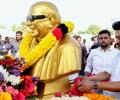
This article traces the history of the DMK's fight for state autonomy, beginning with C.N. Annadurai's advocacy in the 1960s and culminating in M. Karunanidhi's resolution in the Tamil Nadu Assembly in 1974. The article highlights the key figures involved, the arguments presented, and the impact of the Rajamannar Committee Report.
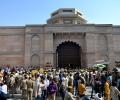
The lawyers of the Hindu side sought time for filing their counter-objection, following which the court of district judge A K Vishvesha fixed November 11 as the next date of hearing in the matter.
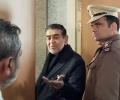
The Supreme Court has expressed its dissatisfaction with the Delhi Police's handling of appeals against acquittals in the 1984 anti-Sikh riots cases. The court emphasized the need for serious and earnest prosecution, not just for the sake of it. This comes in the wake of a public interest litigation filed by a former Shiromani Gurudwara Prabhandak Committee member, seeking justice for the victims of the violence.
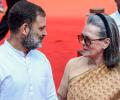
The Enforcement Directorate (ED) has filed a chargesheet in the National Herald case, accusing Congress leaders Sonia Gandhi and Rahul Gandhi of a "criminal conspiracy" to "usurp" properties worth Rs 2,000 crore of its public company AJL by transferring 99 per cent shares for just Rs 50 lakh to their private company Young Indian. The ED has named Sonia Gandhi as accused no 1 and Rahul Gandhi as accused no 2 in the chargesheet, which was filed under various sections of the Prevention of Money Laundering Act (PMLA).
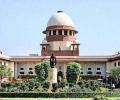
The Supreme Court of India has scheduled a hearing on February 19 for pleas challenging the appointment of the Chief Election Commissioner and Election Commissioners under the 2023 law. The court emphasized the potential consequences if any action is taken before the hearing. The pleas argue that the 2023 law, which excludes the Chief Justice of India from the selection panel, undermines the independence of the Election Commission and allows for undue influence from the executive branch. The court's earlier verdict in March 2023 called for an independent selection panel comprising the Prime Minister, Leader of the Opposition, and the Chief Justice of India to ensure the integrity of the Election Commission. The case highlights concerns about the independence of India's electoral process and the potential for political influence in the appointment of key election officials.
The Supreme Court on Friday refused to entertain a public interest litigation (PIL) seeking a probe into the Hathras stampede that left 121 dead, and asked the petitioner to move the Allahabad high court.

He said the multi-party committee formed by the Speaker in Himachal Pradesh would discuss all issues about street vending on October 3. Singh's remarks came a day after the Congress top brass chided him over his remarks on mandatory display of names by the street vendors and told him that no one was allowed to go against the party's policies and ideologies.
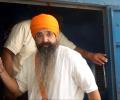
The Supreme Court of India has directed the President to consider the mercy petition of Balwant Singh Rajoana, a death row convict in the 1995 assassination case of former Punjab Chief Minister Beant Singh. The court gave the President two weeks to decide on the plea. Rajoana was sentenced to death in July 2007 for his role in the bombing that killed Beant Singh and 16 others. The Shiromani Gurdwara Parbandhak Committee (SGPC) filed a mercy petition on his behalf in 2012.

The Supreme Court of India has announced its intention to establish an effective mechanism to address caste-based discrimination in educational institutions throughout the country. The court directed the University Grants Commission (UGC) to draft regulations to prevent such discrimination and to provide data on institutions that have implemented equal opportunity cells as mandated by the 2012 UGC equity regulations. The court's decision stems from a public interest litigation filed in 2019 highlighting the prevalence of caste-based discrimination in higher education institutions and its tragic consequences, including the suicides of students like Rohith Vemula and Payal Tadvi.

The apex court had decided to hear the pleas related to the IOA and the AIFF together.

President-elect Donald Trump announced a slate of key Cabinet nominations, including tapping former Democratic presidential candidate Robert F. Kennedy Jr. as his Secretary of Health and Human Services and former Congressman Doug Collins of Georgia as Secretary for Veterans Affairs. Trump also named Jay Clayton as US Attorney for the Southern District of New York, Todd Blanche as Deputy Attorney General, and Dean John Sauer as Solicitor General of the United States.

'The state of Gujarat was to my mind 'partisan and over enthusiastic' in the way it dealt with remission applications.'

Quoting Greek philosopher Socrates, Justice Bopanna emphasised that there are four qualities that are expected of a judge -- to hear courteously, to consider soberly, to answer wisely and to decide impartially.

The Indian government has refused to accept recommendations for a 10% pension increase for retired regular Army captains under the One Rank One Pension (OROP) scheme. The Supreme Court heard an appeal by the government challenging an Armed Forces Tribunal order that mandated a decision on pension for retired captains. The government's decision not to accept the recommendations has led to a delay in resolving pension anomalies for these officers. The case will be heard again on December 12, 2023.
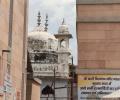
The Supreme Court's 2023 order refusing to stay a scientific survey at the Gyanvapi Mosque complex has sparked claims over several other disputed places of worship across India. This has led to several court cases, including one in Mathura where a survey of the Shahi Idgah Mosque complex was ordered, and another in Ajmer where a claim was made that a Shiva temple existed within the dargah of Sufi saint Moinuddin Chishti. The article also highlights a dispute over the Bhojshala in Madhya Pradesh, which Hindus consider a temple and Muslims consider a mosque. The Supreme Court's order has reignited debates about the Places of Worship (Special Provisions) Act, 1991, which prohibits the change of character of religious places as they existed on August 15, 1947.
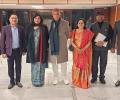
Opposition MPs, some of whom have given their dissent, slammed the exercise as undemocratic, claiming that they were given little time to study the final report and frame their dissent notes.
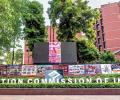
The Supreme Court will hear on February 19 pleas challenging the appointments of the Chief Election Commissioner and Election Commissioners under the 2023 law. The court will take up the matter on a priority basis, after some urgent listed matters. The government has appointed a new CEC and ECs under the new law, which excludes the Chief Justice of India from the selection panel, despite a 2023 Supreme Court verdict directing the inclusion of the CJI in the panel. The petitioners argue that the exclusion of the CJI undermines the independence of the election commission.

Additional Sessions Judge Hardeep Kaur was hearing the arguments regarding the applications. Special Public Prosecutor Atul Shrivastava cited a Supreme Court judgment and said the accused had to approach the police commissioner, who would then form a committee regarding the same.
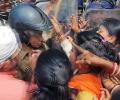
The Supreme Court on Monday refused to entertain a PIL seeking a court-monitored CBI or SIT probe into the violence in West Bengal's Sandeshkhali village, saying the incidents cannot be compared to the savagery in Manipur.
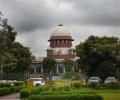
The top court remarked that there is no place for flamboyance in judiciary.

The meeting lasted for nearly two hours, sources said.

Former Resolution Professional of insolvency-bound edtech firm Byju's has moved appellate tribunal NCLAT challenging disciplinary action recommended against him by the Bengaluru bench of NCLT.

On Thursday, August 8, 2024, an Election Commission team led by Chief Election Commissioner Rajiv Kumar arrived in Srinagar to meet with representatives of political parties.
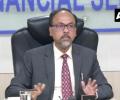
'It is imprudent on the part of Indian insurance companies to invest out of the shareholders' fund in a private limited company.'

The Lokpal has been working without its regular chief after Justice Pinaki Chandra Ghose completed his term on May 27, 2022.
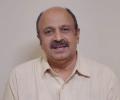
The Supreme Court is scheduled to hear on September 30 the plea of Malayalam film actor Sidhique challenging the Kerala high court order denying him anticipatory bail in a rape case.
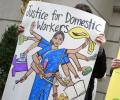
The Supreme Court of India directed the government to establish a legal framework to protect domestic workers and address their exploitation.

The controversy has sparked reactions across states. The famous Mankameshwar temple in Uttar Pradesh has now banned offerings of 'prasad' bought by devotees from outside and said they can offer homemade 'prasad' or fruits.
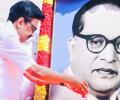
Given the possibilities that next year's assembly elections could throw up, Stalin told the state assembly that an interim report had to be submitted by January 2026. The outcomes may well find its way into the DMK's poll manifesto, thus seeking to keep the electoral focus still on the BJP-ruled Centre and Prime Minister Modi, observes N Sathiya Moorthy.

The opposition parties and some former CECs had opposed the move, saying it will go against the independence of the institution.
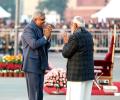
The BJP had no option but to get Jagdeep Dhankhar out of its way for the sake of the Modi government's stability, reveals Sheela Bhatt, the legendary political journalist.
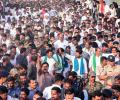
'For the first time in this country, perhaps the first time anywhere, we are going to use backwardness index.' 'It is a fundamental shift in the discourse in the country's social justice.'
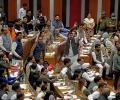
The municipal House failed to elect a mayor on Monday after a ruckus erupted over the nominated members being allowed to vote in the election to the post.
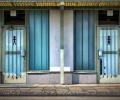
The Supreme Court of India has directed all high courts, state governments, and union territories to ensure the availability of separate toilet facilities for men, women, persons with disabilities (PwDs), and transgender persons in all court premises and tribunals across the country. The court stressed the importance of public health and the right to privacy, stating that adequate public toilets protect women and transgender persons. The court also expressed concern about the condition of public toilets near toll plazas on national highways and emphasized the need for proper sanitation facilities in court premises for judges, advocates, litigants, and staff members. This decision highlights the importance of access to basic amenities in ensuring a fair and dignified justice system.
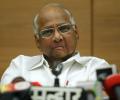
The Justice Lodha Panel had recommended a slew of structural reforms in the BCCI, which were approved by the Supreme Court.

Managing committee of the Maharashtra Cricket Association (MCA) has agreed to adopt the recommendations of the Justice R M Lodha committee.
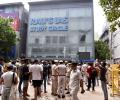
As per the cause list of October 21 uploaded on the apex court's website, a bench of Justices Surya Kant and Ujjal Bhuyan is slated to hear the matter.

The Supreme Court has adjourned pleas challenging the appointments of the chief election commissioner (CEC) and election commissioners (ECs) under the 2023 law. The court indicated the matter would be listed after the Holi festival break due to a paucity of time. Petitioners, including the NGO Association for Democratic Reforms, argued for an urgent hearing, emphasizing the importance of the issue and the potential impact on democratic processes. The appointment of the new CEC and ECs under the 2023 law, which excludes the Chief Justice of India from the selection panel, has been a point of contention, with petitioners alleging it undermines the independence of the election commission.
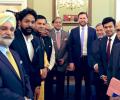
The reality is that far from being friendless, India is better positioned in the world than at any point post-Cold War, asserts Shekhar Gupta.
 © 2026 Rediff.com - Advertise with us - Disclaimer - Privacy Policy - Sitemap - Feedback - About us - Terms of use - Grievances